Free fleet templates
Pre-Trip Inspection Checklist
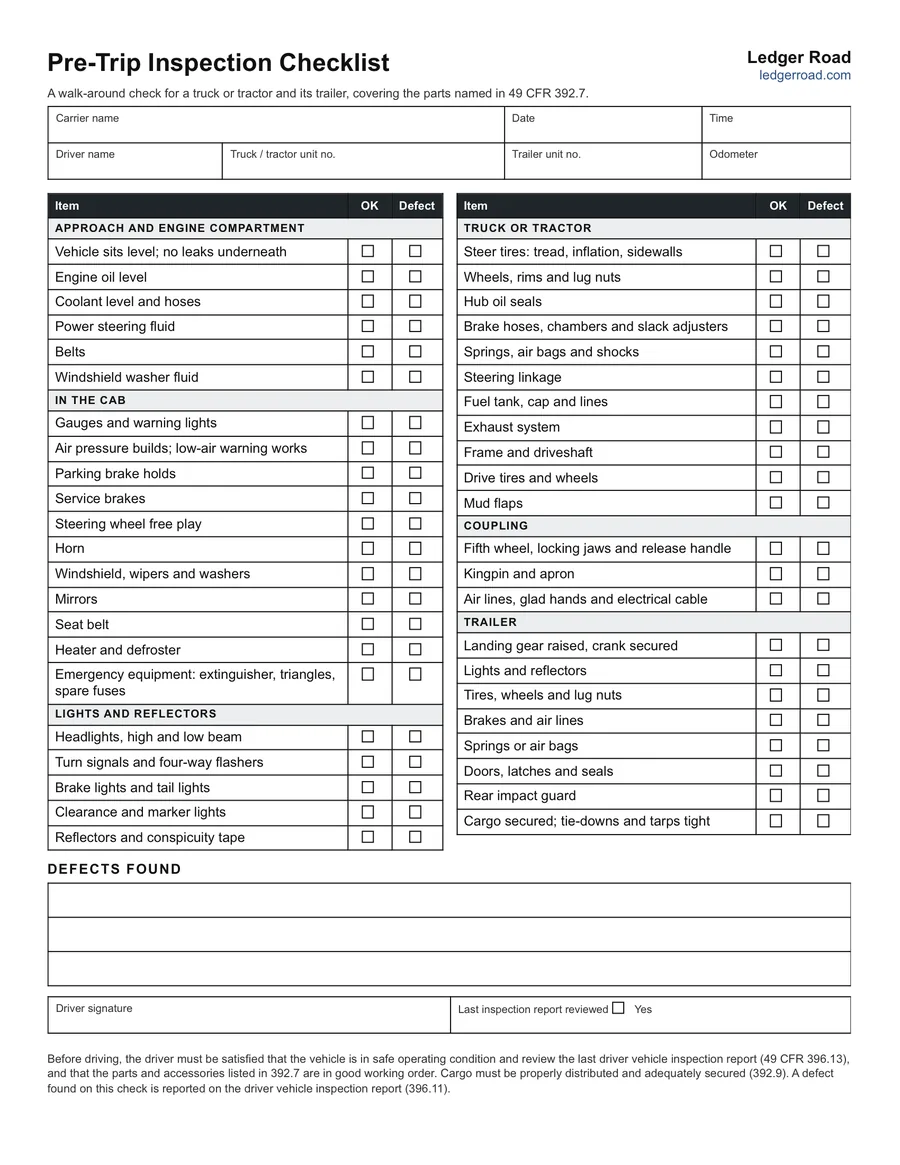
A one-page DOT pre-trip inspection checklist for a truck or tractor and its trailer. Forty-four items in the order of a walk-around, each with an OK and a Defect box, covering every part 49 CFR 392.7 names. It comes as a PDF to print and a Word file to edit.
No signup needed. Print as many copies as you like; it fits a single US Letter page.
What's on the checklist
The top block takes the carrier, driver, date and time, truck and trailer unit numbers and the odometer. The items follow the route a driver walks:
- Approach and engine compartment: how the vehicle sits, leaks, oil, coolant, power steering fluid, belts and washer fluid.
- In the cab: gauges, air pressure and the low-air warning, parking and service brakes, steering play, horn, wipers, mirrors, seat belt, heater and defroster, and the emergency equipment.
- Lights and reflectors: headlights, turn signals and flashers, brake and tail lights, clearance and marker lights, reflectors and conspicuity tape.
- Truck or tractor: steer tires, wheels and lug nuts, hub seals, brake hoses and slack adjusters, suspension, steering linkage, fuel tank, exhaust, frame and driveshaft, drive tires and mud flaps.
- Coupling: fifth wheel and locking jaws, kingpin and apron, air lines, glad hands and the electrical cable.
- Trailer: landing gear, lights, tires and wheels, brakes, suspension, doors, the rear impact guard and cargo securement.
Below the list there is room to describe defects, a signature line and a box to tick once the last inspection report has been reviewed.
What the rules ask for before a trip
Before driving, a driver has to be satisfied that the vehicle is in safe operating condition, review the last driver vehicle inspection report and sign it if defects were listed (§396.13). Section 392.7 names the parts that must be in good working order: service brakes and trailer brake connections, parking brake, steering, lighting devices and reflectors, tires, horn, wipers, mirrors, coupling devices, wheels and rims, and emergency equipment. Cargo has to be properly distributed and secured (§392.9). The checklist has a line for each.
Pre-trip check and DVIR: which form is which
This checklist is for the walk-around before the trip. The driver vehicle inspection report is the written report at the end of the day, required when a defect is found or reported. A defect found on the pre-trip goes on the DVIR, where the carrier certifies the repair and the next driver signs. The DVIR form is a separate download.
An example walk-around
A driver picks up Truck 14 and Trailer 208 at 5:40. Under the hood and in the cab everything is ticked OK. On the lights check the left rear clearance lamp on the trailer is out, so Defect is ticked on that line and "left rear clearance lamp out, trailer 208" goes in the defects box. The lamp is replaced before the truck leaves and the defect is written on the day's DVIR with the repair.
Getting drivers to use it
- Keep the order. The items run in the order of the walk, so a driver finishes back at the cab door with nothing skipped.
- Write the defect in words. A tick in the Defect box says where; the defects box says what.
- Use real unit numbers. The truck and trailer numbers should match your maintenance records.
Questions
Is this the pre-trip inspection for the CDL skills test?
No. The CDL test follows the script in your state's CDL manual, where you name and explain each part to the examiner. This checklist is a working driver's daily walk-around.
Does the DOT require a written pre-trip inspection?
The driver must be satisfied the vehicle is in safe operating condition and review the last inspection report before driving (49 CFR 396.13, 392.7). The written report the rules ask for is the one at the end of the day when a defect is found (396.11). Many carriers keep a written pre-trip as company policy.
Can I use it for a box truck or straight truck?
Yes. Fill in the truck sections and leave Coupling and Trailer blank.
How long do we keep completed checklists?
Federal rules set no retention period for a pre-trip sheet. Driver vehicle inspection reports are kept for three months, and many carriers file the two together for the same period.
Related
Get the DVIR form for the end-of-day report →