Free fleet templates
DOT Accident Register Template
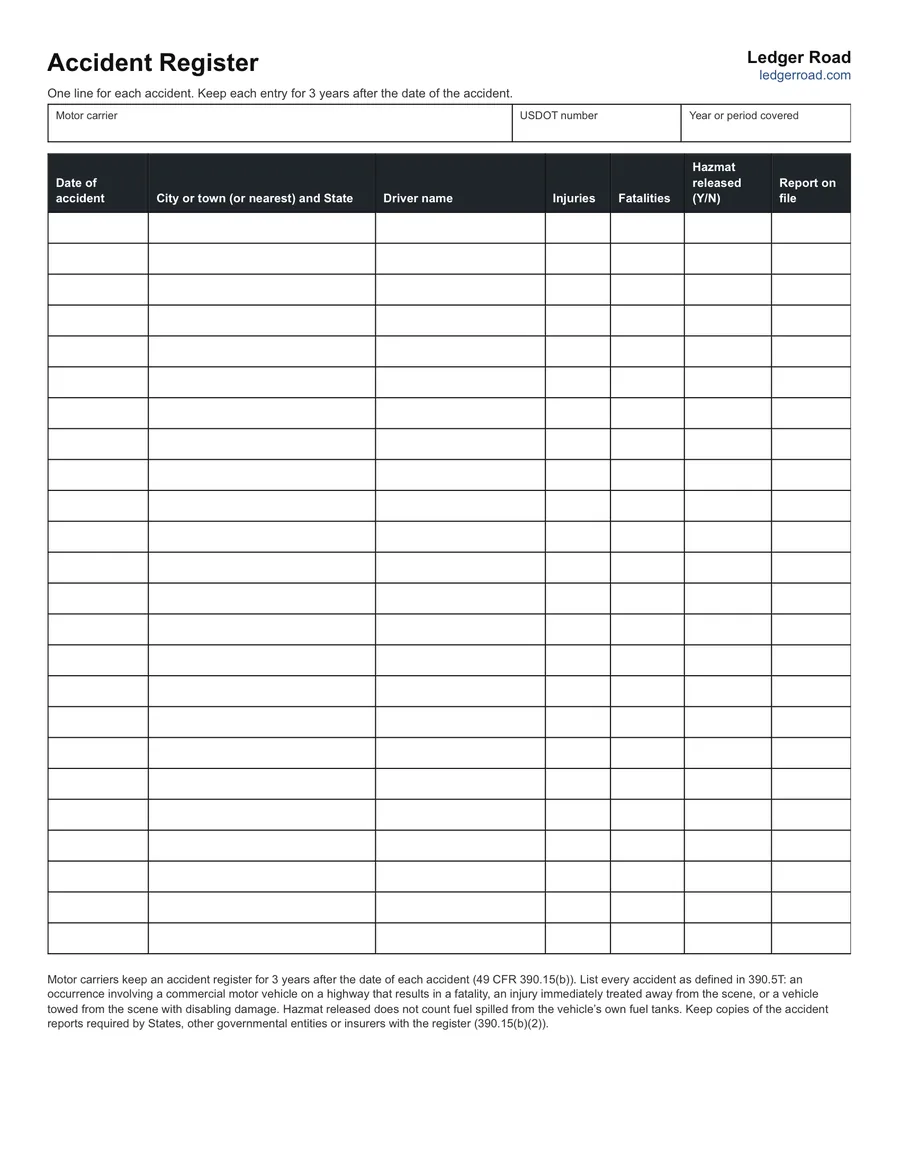
A one-page accident register with a line for each accident and the six items 49 CFR 390.15(b) asks for. It comes as a printable PDF, a Word document and an Excel register that works out how long to keep each entry.
No signup needed. All three files are free to use and change.
What's on the register
The top block names the motor carrier, its USDOT number and the year or period the sheet covers. Each line below is one accident, with the six items §390.15(b)(1) lists:
- Date of the accident
- City or town where it happened, or the nearest one, and the State
- Driver name
- Number of injuries
- Number of fatalities
- Whether hazardous materials were released, other than fuel spilled from the vehicle's own fuel tanks
A last column records whether the accident reports are on file. The printable sheet has 24 lines; the Excel register has 60 and a "Keep until" date for each.
Which accidents to list
The rule uses the definition in §390.5T. An accident is an occurrence involving a commercial motor vehicle operating on a highway that results in a fatality, an injury to a person who immediately receives medical treatment away from the scene, or one or more vehicles with disabling damage that have to be towed or carried away. An occurrence that involves only getting on or off a stationary vehicle, or only loading or unloading cargo, is not an accident under the definition.
What to keep with it
The register also includes copies of all accident reports required by States, other governmental entities or insurers (§390.15(b)(2)). Keep them behind the sheet or in a folder named for the accident date, so the line and its reports are found together.
How long to keep it
Each entry stays for three years after the date of the accident. Start a new sheet each year if that is easier, and keep the old ones until their last entry is three years old. The record retention guide lists the other DOT records and their periods.
An example entry
On March 14 a driver is rear-ended on I-40 near Amarillo and the other driver is taken to a hospital. The trailer is repaired on site and nothing leaks. The line reads: March 14, Amarillo TX, the driver's name, 1 injury, 0 fatalities, hazmat released N, report on file once the police report and the insurer's report are in the folder.
Where it comes up
A DOT audit asks for the accident register along with insurance, the MCS-150 and copies of crash reports. The DOT audit guide covers the rest of what is asked for.
Questions
Do we need an accident register if we have had no accidents?
The rule asks for a line for each accident, so with none there is nothing it requires you to list. Keeping the sheet with your carrier name, the period it covers and no lines is still the quickest answer when an auditor asks for the register.
Which accidents go on the register?
Those that meet the definition in 49 CFR 390.5T: a commercial motor vehicle on a highway is involved and there is a fatality, an injury where the person is immediately treated away from the scene, or a vehicle towed from the scene with disabling damage. A minor scrape with none of those is not listed.
Does it matter who was at fault?
No. The register lists every accident that meets the definition, whoever caused it.
How long do we keep each entry?
Three years after the date of the accident (49 CFR 390.15(b)). The Excel version works out that date for each row.
Is this the same as a vehicle accident report form?
No. An accident report describes one crash for a State, an insurer or your own file. The register is the one-line-per-accident list a motor carrier keeps, and copies of those reports are kept with it.
Related
Read what a DOT audit asks for →
Read the DOT record retention guide →