Free fleet templates
Trailer Inspection Checklist
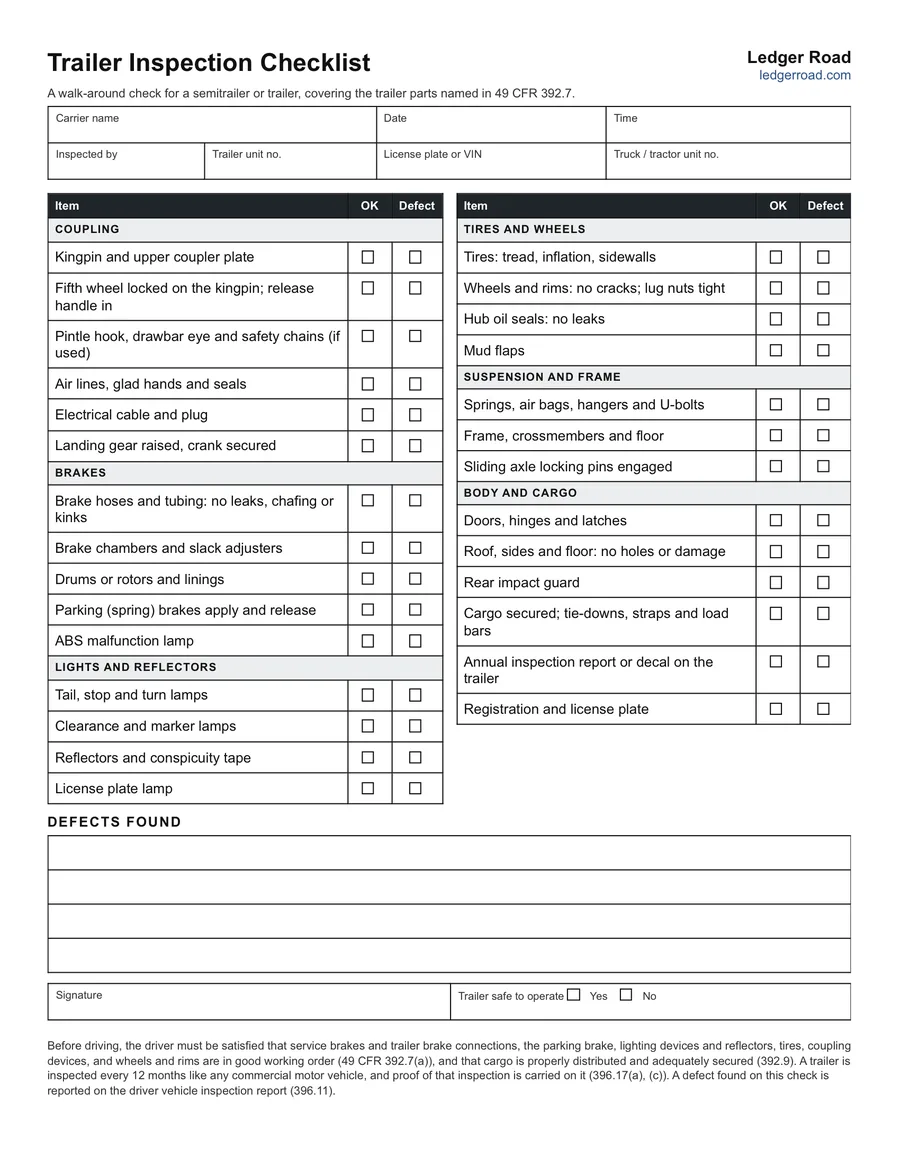
A one-page walk-around checklist for a semitrailer or trailer: 28 items in six groups, each with an OK box and a Defect box. It comes as a PDF to print and a Word file you can edit.
No signup needed. Print as many copies as you like; it fits a single US Letter page.
What's on the checklist
The top block has the carrier, the date and time, who inspected, the trailer unit number, its plate or VIN and the tractor it is coupled to. Below are 28 items in the order of a walk from the nose to the rear:
- Coupling: kingpin and upper coupler plate, fifth wheel lock, pintle hook and safety chains where used, air lines and glad hands, electrical cable, landing gear
- Brakes: hoses and tubing, chambers and slack adjusters, drums or rotors and linings, parking brakes, ABS lamp
- Lights and reflectors: tail, stop and turn lamps, clearance and marker lamps, reflectors and conspicuity tape, plate lamp
- Tires and wheels: tires, wheels, rims and lug nuts, hub oil seals, mud flaps
- Suspension and frame: springs or air bags, frame and crossmembers, sliding axle locking pins
- Body and cargo: doors and latches, roof, sides and floor, rear impact guard, cargo securement, the annual inspection report or decal, registration and plate
Four lines for defects, a signature and a "Trailer safe to operate" yes or no close the sheet.
When to use it
Before a trip, a driver has to be satisfied that the parts §392.7 names are in good working order. For a trailer those are the service brakes and trailer brake connections, the parking brake, lighting devices and reflectors, tires, coupling devices, and wheels and rims. Cargo has to be properly distributed and secured (§392.9). Fleets also use the sheet when a trailer is picked up or dropped, so its condition at each handover is on paper.
Trailers and the annual inspection
A trailer is a commercial motor vehicle for the periodic inspection: in a tractor and semitrailer combination each one is inspected, and neither may be used unless it passed in the preceding 12 months and proof is on the vehicle (§396.17). The last body-and-cargo line on this checklist is that proof. The inspection itself is recorded on the annual vehicle inspection report.
After a defect is found
Write what is wrong and where: "left rear outer tire, sidewall cut" rather than "tire". The defect goes on the driver vehicle inspection report, and the carrier repairs it or certifies that repair is not needed before the trailer goes out again. The DVIR form has the repair certification and the next driver's review.
For the truck as well
The pre-trip inspection checklist covers the truck or tractor and its trailer on one sheet, with 44 items. Use this one when the trailer is checked on its own: drop yards, trailer pools and interchange.
Questions
Is the trailer inspection checklist free?
Yes. There is no signup, and you can print as many copies as you need. It fits one US Letter page.
Does it work for a dry van, a reefer and a flatbed?
Yes. The 28 items are the ones any semitrailer or trailer has. Skip the lines that do not apply, such as doors on a flatbed, and use the defects box for equipment the list does not name, such as a reefer unit or a liftgate.
Is this the annual DOT inspection for a trailer?
No. This is a walk-around check before a trip or when a trailer is picked up or dropped. The annual inspection is a separate, fuller inspection by a qualified inspector; the form for that is the annual vehicle inspection report.
Does a trailer need its own annual inspection?
Yes. Each vehicle in a combination is inspected, so the tractor and the trailer each need one every 12 months, and proof of it is carried on the trailer (49 CFR 396.17(a), (c)).
Where does a defect go?
Write it in the defects box and report it on the driver vehicle inspection report, so the repair and the next driver's review are recorded (49 CFR 396.11).
Related
Get the pre-trip inspection checklist →